Mental Health and Addiction go hand in hand with each other. No matter what substance you are trying to abstain from, it takes a major toll on ones mental health. We’ve put together some helpful information regarding the two subjects. You will find resources to medical journals and papers written by experts. Take a look at the science of what’s going on in your brain!
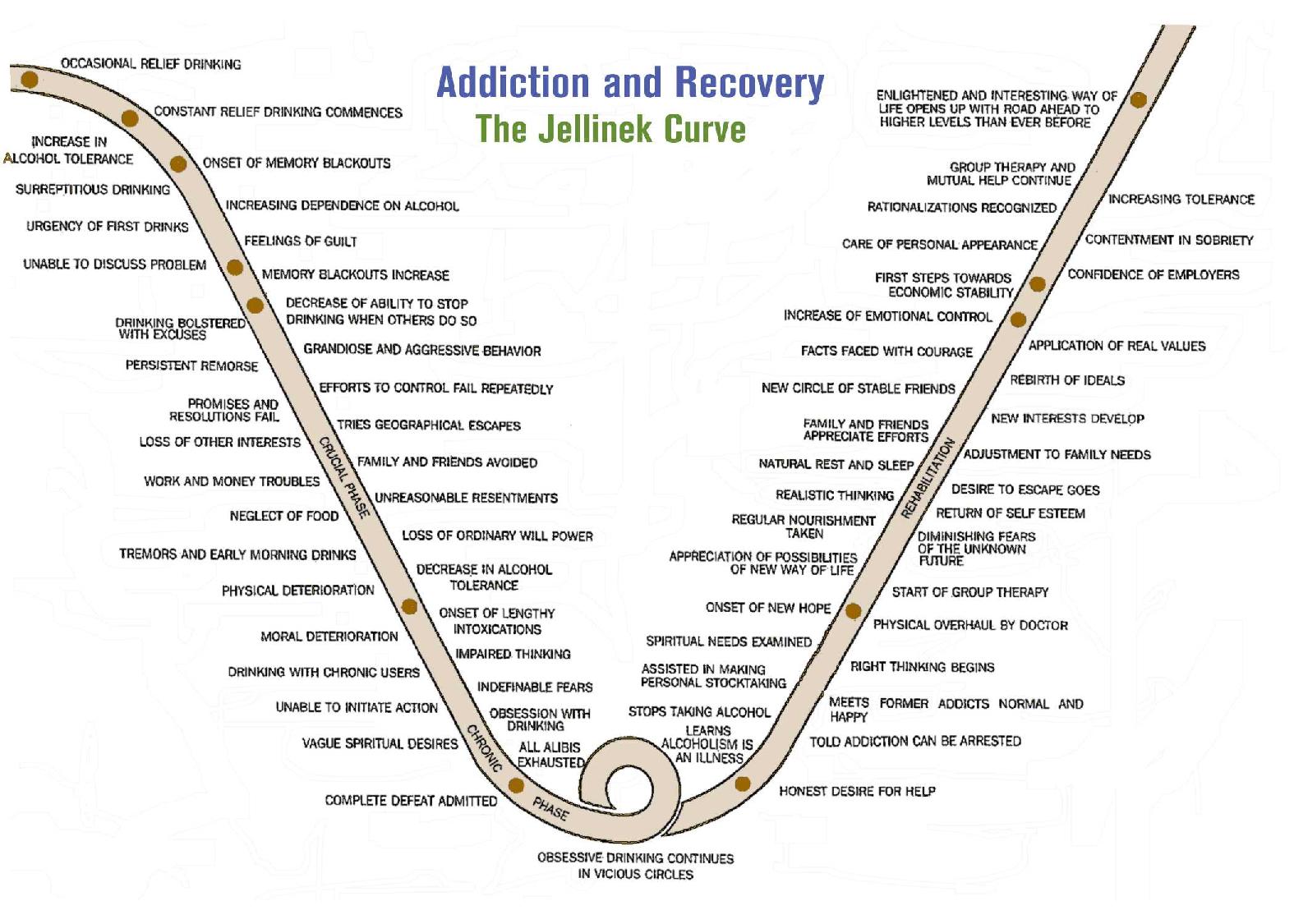
The Jellinek Curve
Sourced from Rutgers University website; The Jellinek Curve, sometimes also called the Jellinek Chart or the Glatt Chart, was not created by E. M. Jellinek. It was Max Glatt, a British physician who added the upswing to Jellinek’s “phases of alcohol addiction” in his article in 1958.
Jellinek’s most widely known contribution to the field of alcohol studies is his concept “phases of progression of alcoholism,” popularly referred to as the ”Jellinek curve.” Originally published as an annex to a 1952 World Health Organization report, his “Phases of alcohol addiction” elaborated on what he considered the four phases every every person with alcohol use disorder experiences.
Within a few years, Max M. Glatt, a doctor and founder of the Alcoholism Treatment Unit at Warlingham Park Hospital in England, noticed that former patients recounted similar recovery experiences after leaving the hospital. Glatt revised Jellinek’s original phases to include this upswing of recovery. He published the article “Group therapy in alcoholism” in the British Journal of Addiction to Alcohol & Other Drugs in July 1958, volume 54, issue 2, pp. 79-151, including the chart that became known as the Jellinek Curve.
Alcohol and the Brain: An Overview
“Source: National Institute on Alcohol Abuse and Alcoholism (NIAAA)”
Alcohol interferes with the brain’s communication pathways and can affect the way the brain looks and works. Alcohol makes it harder for the brain areas controlling balance, memory, speech, and judgment to do their jobs, resulting in a higher likelihood of injuries and other negative outcomes. Long-term heavy drinking causes alterations in the neurons, such as reductions in their size. Below are a few key topics related to alcohol and the brain.
The Adolescent Brain
Adolescent brains are more vulnerable to the negative effects of alcohol than adult brains. Misuse of alcohol during adolescence can alter brain development, potentially resulting in long-lasting changes in brain structure and function.
Alcohol-Induced Blackouts
Alcohol misuse can cause alcohol-induced blackouts. Blackouts are gaps in a person’s memory of events that occurred while they were intoxicated. These gaps happen when a person drinks enough alcohol that it temporarily blocks the transfer of memories from short-term to long-term storage—known as memory consolidation—in a brain area called the hippocampus.
Alcohol Overdose
Continuing to drink despite clear signs of significant impairments can result in an alcohol overdose. An alcohol overdose occurs when there is so much alcohol in the bloodstream that areas of the brain controlling basic life-support functions—such as breathing, heart rate, and temperature control—begin to shut down. Symptoms of alcohol overdose include mental confusion, difficulty remaining conscious, vomiting, seizure, trouble breathing, slow heart rate, clammy skin, dulled responses (such as no gag reflex, which prevents choking), and extremely low body temperature. Alcohol overdose can lead to permanent brain damage or death.
Alcohol Use Disorder
As individuals continue to drink alcohol over time, progressive changes can occur in the structure and function of their brains. These changes can compromise brain function and drive the transition from controlled, occasional use to chronic misuse, which can be difficult to control and lead to alcohol use disorder (AUD). Individuals with moderate to severe AUD may enter a cycle of alcohol addiction. The extent of the brain’s ability to return to normal following long-term sobriety is not fully understood, but a growing number of studies indicate that at least some AUD-induced brain changes—and the changes in thinking, feeling, and behaving that accompany them—can improve and possibly reverse with months of abstinence from drinking. (More detail about the neuroscience of AUD is provided in the Neuroscience: The Brain in Addiction and Recovery section of The Healthcare Professional’s Core Resource on Alcohol.)